The Philosophy of Vibe Coding: Ship Fast, Learn Faster
Why building quickly, imperfectly, and joyfully works

If you’ve ever spent a whole week planning the “perfect” project… only to scrap the plan the moment you actually started, then guess what? You’ve already been vibe coding.
Vibe coding is not just about going fast: it’s a whole way of approaching creative work. A bit of craft, a bit of curiosity, and a healthy dose of “eh, let’s just give it a go.”
And before you roll your eyes and call it fluffy nonsense, here’s the secret: vibe coding isn’t about cutting corners. It’s about focusing on the steps that help you learn and grow.
If my earlier posts focused on the how (The How to Vibe Code for Free series, Rapid Prototyping), this one’s the why.

What Is Vibe Coding, Really?
Vibe coding is really just the art of staying in flow: following your instincts, building just enough to learn something, and making choices based on real feedback rather than overthinking everything in your head. (If you’re new to the idea altogether, I explain the basics in Getting Started with Vibe Coding.)
It’s not an excuse for chaos, though. It’s speed with purpose. Momentum that teaches you faster than perfection ever could.
Think of it like jazz: there’s structure, sure, but the magic happens in the improvisation.
That’s how indie builders and startup teams ship something users love while everyone else is still polishing pitch decks.
There’s a new kind of coding I call “vibe coding”, where you fully give in to the vibes, embrace exponentials, and forget that the code even exists. (Andrej Karpathy)
Core Principles
1️⃣ Flow Over Friction
The goal is simple: keep your rhythm.
Little annoyances, like slow setup screens, glitchy previews, that nagging feeling you’ve forgotten something, they all chip away at your momentum. From the outside, you look busy; on the inside, you’re just wrestling with your tools instead of actually making anything. (If you want my favourite low-friction tools, I listed them in How to Vibe Code for Free.)
Protect your flow like it’s sacred:
Turn off notifications while you build.
Use tools that just work, even if they aren’t trendy.
Keep a simple checklist of where you left off.
Momentum beats mood.
2️⃣ Iteration Over Perfection
Perfect is the enemy of good. (Voltaire… possibly)
You don’t need to ship the final app, just a version that works.
Build → test → tweak → repeat.
Each iteration teaches you what to keep and what to ditch.
Make it work → make it useful → make it nice.
Don’t let perfectionism talk you out of shipping.
(I break this down step-by-step in Rapid Prototyping if you want the practical version.)
3️⃣ Simplicity Over Complexity
Simplicity makes everything easier to understand.
You can build the fanciest system in the world, but if people can’t use your app, it’s just decoration.
Simple doesn’t mean stripped-down. It means easy to follow. Build for people, not for the little perfectionist gremlin in your head.
And if a quick hack gets things moving? Go for it. Just leave yourself a note for future-you, who will absolutely have forgotten why you did it.

Practical Techniques for Staying in Flow
The 15-Minute Reset
If you’re stuck for more than 15 minutes, walk away.
Make tea, stretch, or ask your AI copilot to reframe the problem.
Half the time, clarity arrives with the kettle.
Code in Layers
Work in visible, satisfying layers:
Make it work → get the messy version running.
Make it right → fix the bugs and user experience friction.
Make it fast → optimise what’s slow.
Make it beautiful → polish at the end.
Progress, not perfection, is your rhythm.
Throwaway Prototypes Are Fine
Sometimes the only way to understand an idea is to build it badly first.
Delete it later if you like — it still taught you something.
Progressive Enhancement Wins
Start small, then enhance your app for your fans and power users.
You’ll serve everyone better — and keep your sanity intact.
Mini Challenge:
Try building something you can finish in under 90 minutes.
You’ll learn more in one messy sprint than in a week of planning.
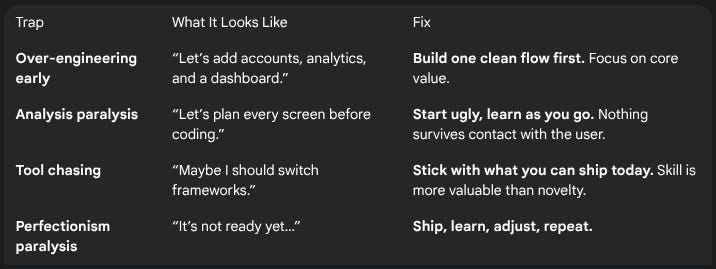
🚫 Anti-Patterns to Avoid
Final Thought
Vibe coding comes from curiosity, not shortcuts.
It’s the creative craft of trying, learning, and improving.
The “best” code isn’t the cleverest or the most architecturally impressive. It’s the one that actually helps someone… and doesn’t leave you exhausted in the process.
So go build the small thing.
See how it lands. Iterate.
And if it brings even a spark of joy to someone — including you — that’s your win.
Because at the end of the day:
Plans don’t ship. Vibes do.
💌 Call to Action
Next up: Imposter Syndrome for Vibe Coders & The Myth of the “Real Developer”.
Subscribe below to get it straight to your inbox when it drops.
Such a brilliant take! This truely puts into words what I've felt in so many projects. It's like finding the hidden truth behnid effective learning, both in coding and life. How amazing is it to trust your instincts more? This makes me wonder about all the possibilities unlocked.
I hear you. I have countless of half-baked and never started projects, because I got bogged down in trying to figure out the tiny details and giving up after realising the vast amount of knowledge I was missing.
Not anymore! It’s time to make/do things! 🦾